Monthly Archives: January 2021

New ideas in science can take ages to be understood and accepted

When recently participating in the jury process for the assessment of a student’s PhD thesis on palaeoweathering and surficial albitization in Spain (see previous article; https://bit.ly/2MmRMDZ), I summarized the difficulties faced by me and my students over many years in getting our observations and interpretations published and eventually (though perhaps reluctantly) accepted by the geological community in Europe .  This story began almost 50 years ago when my detailed studies of albitization in surficial landscapes across France and elsewhere in western Europe commenced.  The alteration had long been recognized but never seriously investigated.  My story begins:

“During 1976-79 J-J Yerle completed a PhD on uranium deposits hosted in Permo-Carboniferous sediments in Rouergue (SW Massif Central).  It included studies of core from numerous drillholes and was accompanied by extensive mineralogical analyses using X-ray diffraction.  The major results were as follows: a fine-grained facies containing ~90% albite with no quartz or K-feldspar was encountered in the core; it appeared to have developed by albitization accompanied by chloritisation of biotite, but the intensity of the alteration decreased with depth and eventually disappeared.  Dr Yerle initially considered a syn-sedimentary model for the albitization but K-Ar dating pointed to a Triassic age which suggested a palaeoweathering model post-dating sedimentation.  None of our colleagues could accept this interpretation:  five days before the formal defence of Dr Yerle’s thesis one colleague entreated the Institute Director to cancel the proceedings.

“From 1978-86 Dr J-M Schmitt was employed by the Ecole des Mines de Paris and commenced a doctorat es Sciences thesis on a uranium mine hosted in a gneiss in northern Rouergue focussing on albitization.  He was able to demonstrate a clear decrease in the abundance of albite with depth in the profile; the geopetalcharacteristics of the profile, particularly its termination at depth where alteration was restricted only to fractures; and radiochronological data defining a Triassic age for the alteration.  However, even this scholarly work did not convince colleagues and associates.  On the contrary, many petrographers were opposed to the interpretation on the basis that they ‘knew’ that albitization could develop only at depth and at high temperatures – albite ‘could not’ form at low temperatures.

“During 1982-86 J-Y Clément undertook another PhD thesis on uranium deposits hosted in the Permian Lodève Basin, South of Rouergue.  Here, the host sediments are clastics with interstratified ash layers.  The base of the sequence is dark coloured and greenish; the top is red.  This colour change had been thought of as an original facies character of the sequence.  Dr Clément carefully described a profile consisting of an uppermost clay-enriched zone, an underlying zone in which the only feldspar present was pure albite (together with analcime); and a deeper zone containing secondary albite + Kfeldspar.  The alteration did not persist at depth.  All alteration horizons were discordant with the stratigraphy and were preserved under a Triassic sedimentary cover, which led to them being attributed to an infra-Triassic age.  Dr Clement correlated this profile and the accompanying alteration with Dr Schmitt’s Rouergue albitization, the latter occurring on the continental surface upstream of the basin where weathering had persisted after the deposition of the early Trias in the basin.  Yet, these observations and results were not convincing for many of our geologist colleagues.

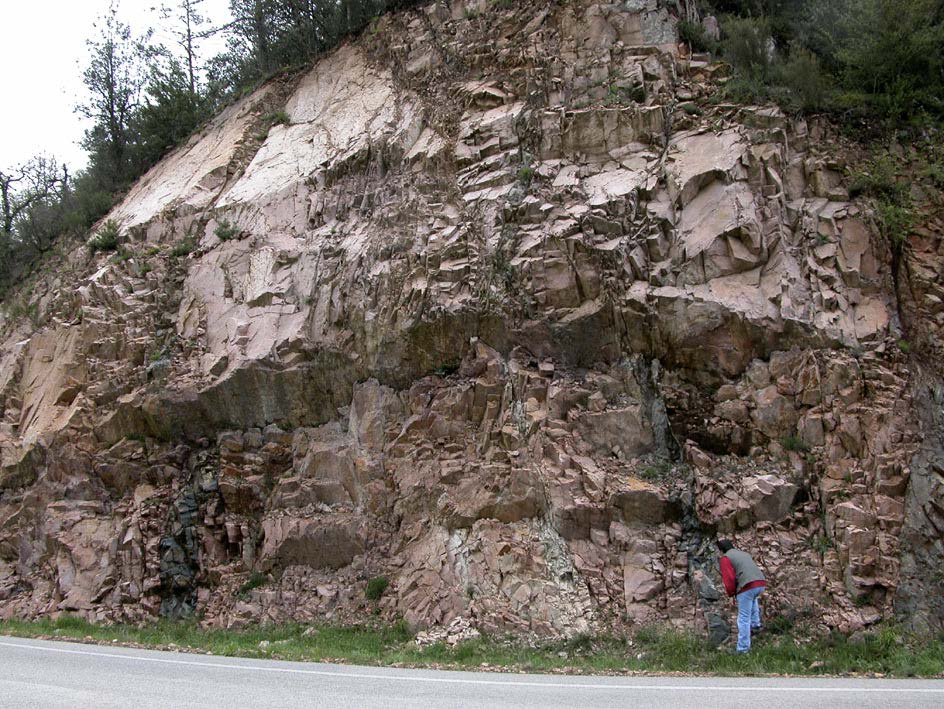
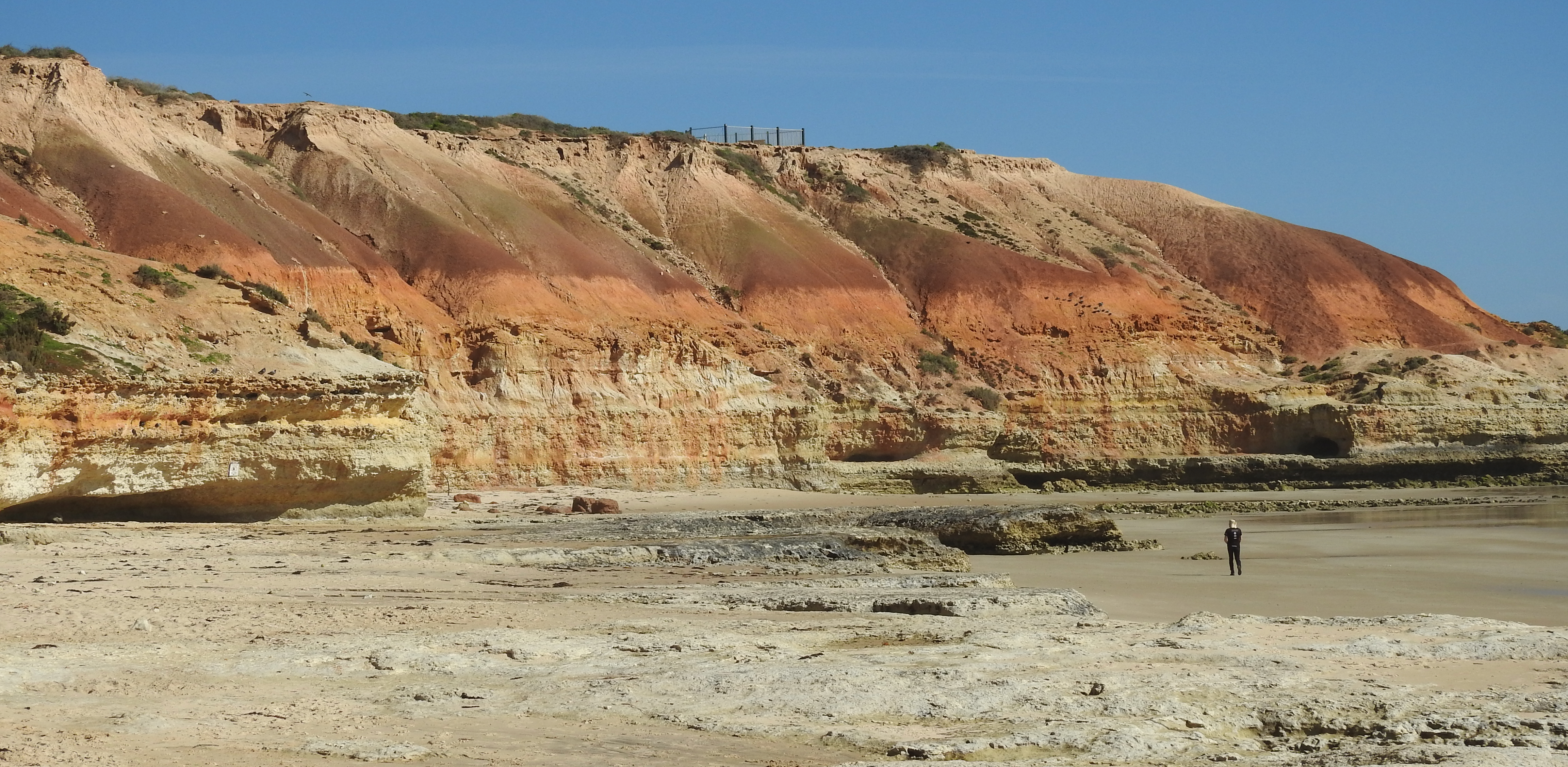
“During the period from 1986 until 2000, about 15 years, we did little further work on the albitization because of our critics: other angles of ‘attack’ on the alteration profiles had to be found.  One such approach came from numerous hikes in the Hercynian mountains and across Triassic palaeosurfaces.  A first clue came from a visit to the albitized Delamerian (Cambrian) granites on the southern coast of South Australia.  Then some traverses through the Morvan where the hilly terrain made it possible to better appreciate the widespread albitized profiles:  these are characterised by fresh, unaltered granites in valleys and pervasive red albitized facies on higher slopes and hilltops.  The same features were examined further north on the Brittany coast and the Vosges Massif, as well as in every part of the Massif Central, the Maures Massif on the French Riviera, at several places in the Alps, around Mont-Blanc, in Central the Spanish Massif and later in  Morocco.
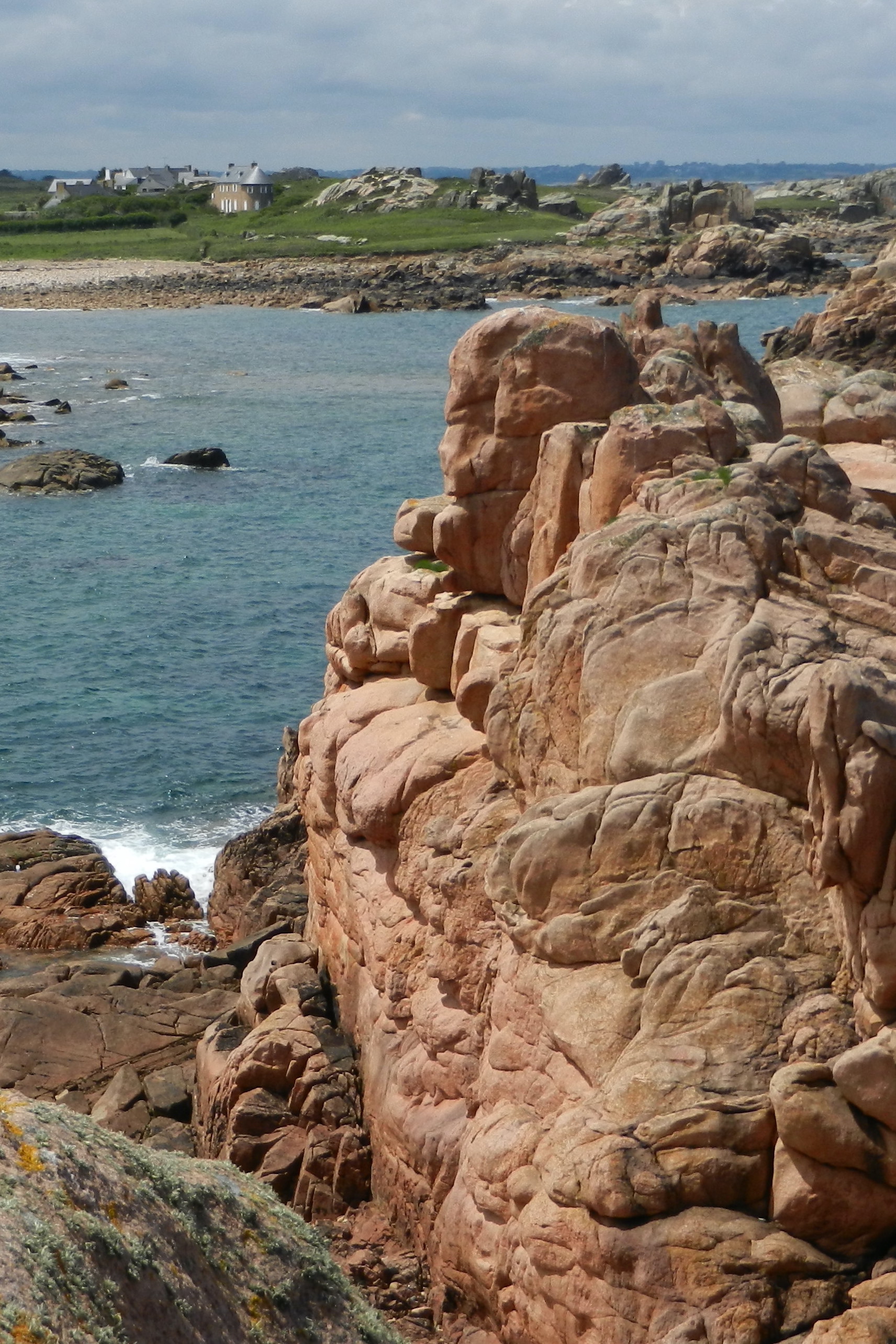
Red albitised granites on the Brittany coast   

“1997 was the ‘tipping point’ when I went to Barcelona for field work on the Monjuic silification.  Dr David Gomez-Gras showed me the paleoweathering features below the Trias.  At each site I was more and more excited by the red facies thought to be the result of Triassic palaeoweathering:  associated with it were magnificent albitized profiles.  A plan was made to bring Dr David Parcerisa to Fontainebleau to undertake post-doctoral research on the Morvan.

“From 2000-2010, with Dr Parcerisa in Fontainebleau, there was a substantial renewal of energy in research on the Morvan albitized profiles.  The work included substantial field mapping and sampling and detailed petrographic studies supplemented by cathodoluminescence.  This gave a clear demonstration of a geopetal profile for the albitization.  But a paper we submitted for publication describing these observations and data was  rejected by a reviewer known as a specialist in albitization in sandstone reservoirs.  One particular dismissive comment from him was that ‘the authors have no experience in albitization and do not even know what albitization means’.  Unfortunately, this is an entrenched opinion offered by so-called peer reviewers on many papers with new ideas and interpretations submitted for publication nowadays. 

During the same period, I had a PhD student (Catherine Recordel) working on paleomagnetic dating of the Siderolithic palaeoweathering profiles on the Massif Central but we struggled to get results.  I suggested that she try to date the red albitized facies and this was successful and, eventually, so was the palaeomagnetic dating of the Siderolithic palaeoweathering profiles.  Dr Ricordel’s paper on the age of the Morvan profile was accepted and this turned out to be the pass for Dr Parcerisa to publish his paper on his petrographic studies!  One step forward – but yet some colleagues were still not convinced.  One petrologist who worked for 30 years on the episyénite albitized facies in the Massif Central told me that he didn’t believe in paleomagnetic dating!

“From 2005-2010 we continued with paleomagnetic dating.  Management in Mines-ParisTech Geoscience decided to promote research on the albitized profiles before I retired, for which I am grateful.  We started with post-doctoral research by Dr Christine Franke and later complemented it with a PhD study by Kouakou Yao.  Dr Yao’s research was focussed on the Sudetes Massif in Southern Poland.  Paleomagnetic dating was also undertaken in the Sudetes, Vosges and Catalonia Massifs.  All produced Triassic ages for the albitization . Extensive drilling in Norway, and additional drilling programs in the Maures Massif, generated very promising cores through albitized profiles.  Later, causal exploration showed albitized geopetal profiles in Ireland, Cornwall and Galicia.

“During the 2010s Dr Carles Fàbrega started research on his thesis and made a significant contribution by means of radiometric dating and isotope analyses of single minerals.  He confirmed the Triassic age for the albitic palaeoweathering profiles and also generated, for the first time, a temperature evaluation consistent with alteration in a palaeosurface or somewhat deeper regolith environment.  This has been a major additional cornerstone for the subject.

“In conclusion:  Max Plank said: A new truth in science never succeeds in triumphing by convincing its adversaries and bringing them to see the light, but rather because finally these adversaries die and a new generation grows, to whom this truth is familiar.’  There is the hope!

“This story evolved over 45 years and there are some lessons about research that extend from it.

  • First you need a basis in field studies to apply your ideas: without fieldwork ideas remain dreams in geology and there are no new ideas.  Observations in the field dictate what is possible (or not) and provides new facts.
  • You never can predict where or when new ideas will arise, and what they might be.  Progress in research is always due to opportunities, field opportunities, meeting with people with different experiences, and opportunities to insert an idea into another’s research program.  Opportunities must be taken as theyarise.
  • The essence of research is not to find out what others have already shown, but to innovate and to follow different pathways: from this springs the excitement of a quest for the unknown.
  • Finally, there is always risk-taking.  This is one difficulty of the multiple research programs that abound at present.  These research programs all aim to guide researchers and limit risk (mostly financial risk, of course) and so they tend to deviate as little as possible from what is already known.  It is a brave agency who will award funds to those who are either little-known or whose proposal does not conform to the orthodoxy.  This approach does not lead to novelty.  It curbs imagination and creativity. 
  • Research is like an unique artwork, a painting or a poem, and it should embody a quest for understanding and a captivating story.

(See also preceding companion article)

Dr Medard Thiry, December 2020
Surficial albitization – palaeoweathering preserved beneath the extensive Triassic unconformity in Western Europe

One form of albitization consists of the replacement (albitization) of Ca-bearing plagioclase by secondary Na-plagioclase (i.e. albite) and is typically accompanied by alteration of biotite to chlorite and the staining of the rock by iron oxide pigments.  In crystalline rocks, albitization is rather widespread but is traditionally considered result from deep and high-temperature metasomatic alteration linked to magma cooling during exhumation.  Studies of albitization have principally been undertaken by petrologists who are mostly interested in the origin and emplacement of granites and naturally focus on aspects of their petrography and the details of their parageneses in this context.  They interpret albitization to be a ‘window’ to post magmatic processes. 

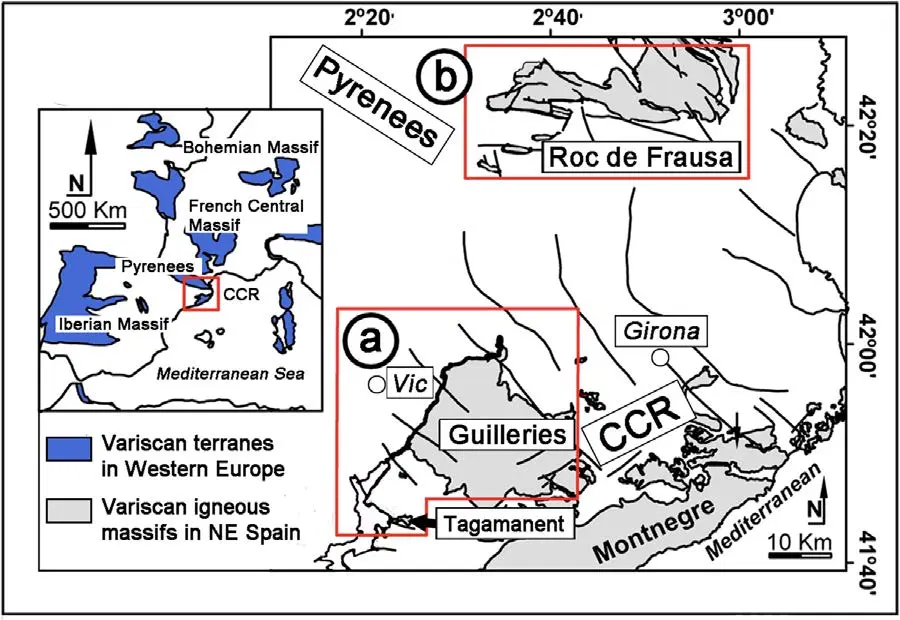
But albitization can also be a consequence of surficial weathering.  The example we studied in Spain (Fig. 1) is widespread and spatially and temporally associated with a Triassic palaeosurface.  Its occurrence forces a completely different point of view about this form of alteration.  A major gap separates the two points of view about albitization and our findings have exposed a ‘cultural barrier’ that has to be breached in order to advance knowledge about this process, particularly where it is found in crystalline rocks.  Key foci in the scientific exchange ought to include the geometry of the alteration in the field, petrographic observations detailing stages in the alteration, and the dating of these stages.

Figure 1. Field locations of albitized granites below the Triassic unconformity in Spain. (a) Guilleries Massif. (b) Roc de Frausa Massif. CCR: Catalan Coastal Ranges. From Fabrega et al. (2019).
Figure 1. Field locations of albitized granites below the Triassic unconformity in Spain. (a) Guilleries Massif. (b) Roc de Frausa Massif. CCR: Catalan Coastal Ranges. From Fabrega et al. (2019).

The outcrop scale

The albitization we have studied in granites is characterised by reddening due to impregnation of the feldspars by iron oxides (Fig. 2).  It results in: (1) a pervasive coloration distributed rather homogeneously within the rock volume, (2) fracture-bound red to pinkish granite facies or (3) spotting when the alteration is weak, resulting in pinkish spots distributed within non-reddened rock.

Figure 2. Strongly albitized Variscan red granites below the Triassic unconformity in the Guilleries Massif, NE Spain.
Figure 2. Strongly albitized Variscan red granites below the Triassic unconformity in the Guilleries Massif, NE Spain.

In terms of structure, a vertical profile of albitized granite, with a typical thickness around 150-200 m, occurs below the Triassic unconformity in the Guilleries and Roc de Frausa Massifs in NE Spain (Fig. 3).  The most intense alteration occurs at the top, immediately below the unconformity, and progressively decreases in intensity with depth.  From the top to the bottom, the alteration facies change from red to pink and ultimately spotted.  Unaltered granites are found below (Fig. 3).

Figure 3. Vertical structure and facies evolution of the albitization profile. Intensity of alteration decreases with depth. (a) Mesozoic sedimentary cover. (b) Red facies. (c) Pink facies. (d) Spotted facies. After Parcerisa et al. (2010).

The microscope scale

Microscope observations of the albitized granites show a suite of reactions in the major minerals including plagioclase albitization, K-feldspar microclinization, biotite chloritization and quartz recrystallization.  Albitization affects the primary plagioclase, where the Ca-bearing cores of the crystals are pseudomorphosed by secondary albite along twin planes and micro-fractures (Fig. 4a, b).  Within this secondary albite, part of the calcium released during plagioclase replacement forms small patches of secondary calcite.  Primary K-feldspar crystals are partially pseudomorphosed by secondary microcline (Fig. 4a).  Biotite and is replaced by secondary chlorite (which contains large numbers of apatite inclusions compared with primary biotite; Fig. 4c), secondary titanite and anatase.  Clusters of rare-earth carbonate minerals, probably synchisite-Ce, can be seen inside the secondary porosity of albitized plagioclase and microclinized orthoclase in backscattered electron-microscope images (Fig. 4d).  Secondary quartz partially replaces primary quartz in the upper part of the profile (Fig. 4e).  Primary and secondary monazite occur at the reaction front between albitized and unaltered granite (Fig. 4f).

Figure 4. Cathodoluminescence and SEM images of albitized granite. Ab1: Primary plagioclase. Ab2: Secondary albite. Ap: Apatite. Cal2: Secondary calcite. Chl2: Secondary chlorite. Kfs1: Primary K-feldspar. Kfs2: Microclinized K-feldspar. Mnz1: Primary monazite. Mnz2: Secondary monazite. Qtz1: Primary quartz. Qtz2: Secondary quartz. Syn2: Secondary Synchysite-(Ce). Tit2: Secondary titanite. From Fabrega et al. (2019).

Age dating

Dating of albitized profiles has been conducted at different sites through Europe using a variety of dating methods, including: (1) K-Ar dating of albite and K-feldspar (Bonhomme et al., 1980; Schmitt et al., 1984); (2) palaeomagnetism of Fe-oxides (Ricordel et al., 2007; Parcerisa et al., 2010; Thiry et al., 2011; Yao et al. 2011, Franke et al., 2011, Yao, 2013) and, most recently, (3) K-Ar microprobe dating of albite and K-feldspar and electron microprobe U-Th-Pb dating of monazite (Fabrega et al., 2019).  All have established that the albitization and associated alteration occurred during the Late Permian to Early Triassic, around 250 Ma, while the Variscan granites were exposed at the landsurface. 

Thus, the red-stained albitization relates specifically to the Triassic palaeosurface and was preserved beneath it by a Mesozoic and Cenozoic sediment cover.  The alteration profiles are palaeoweathering features relating to surficial weathering and were nor much eroded.  The  geopetal organization (decreasing intensity of albitization with depth ending in alteration confined to fractures) is characteristic of weathering and alteration under the influence of geomorphology, climate, and groundwater.

Palaeoenvironmental setting of the alteration

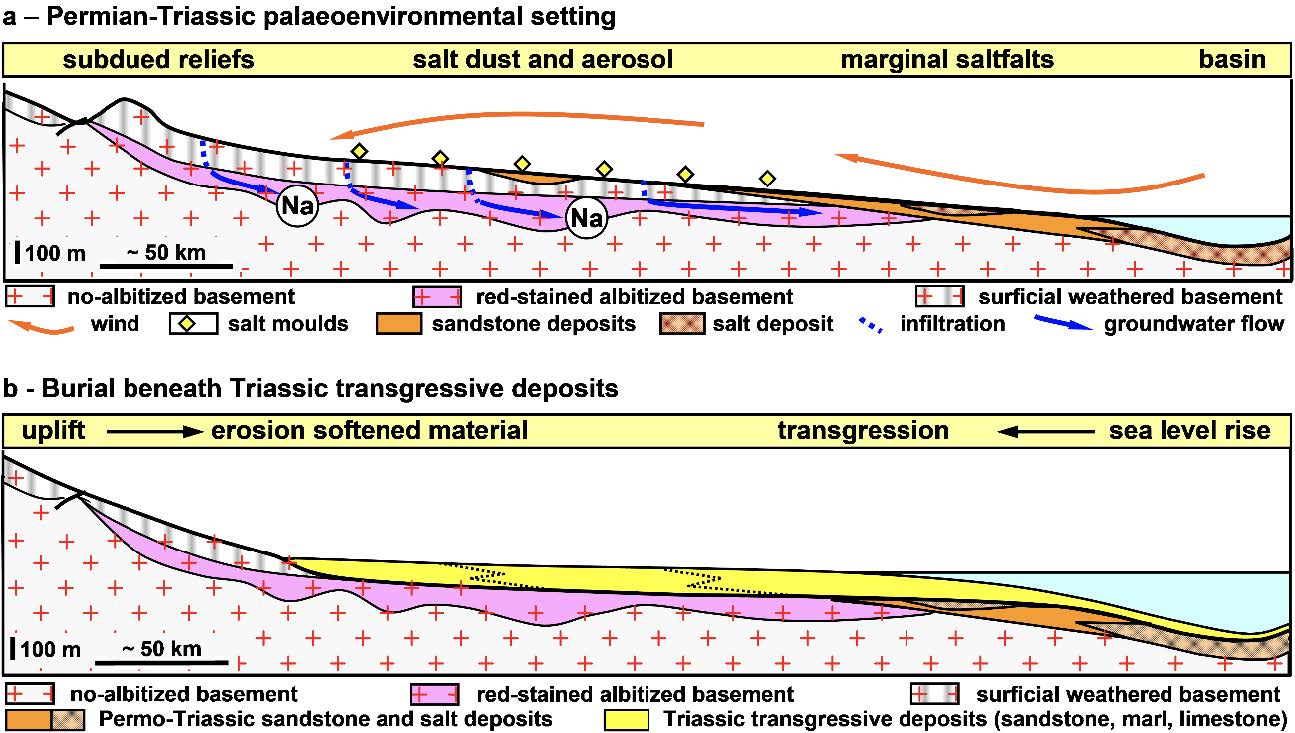
The morphology of the alteration profile and its proximity to the Permo-Triassic palaeosurface suggests that the responsible fluids were Na-rich groundwaters (Fig. 5a).  The depth of the alteration profile, the long-lasting tectonic stability in the region, and the continental scale abundance of saline environments in the Permo-Triassic period were probably key factors in the development of this near-surface weathering event across Europe.  The albitization profiles remained preserved below the Triassic sedimentary cover or, in some cases (Fig. 5b), directly at the surface.  In contrast to the non-albitized granites usually decompose to sandy material when exposed to surface conditions, the albitized granite has an increased resistance to weathering and erosion.

Figure 5. Permo-Triassic setting that facilitated the development (a) and preservation (b) of albitization. From Fabrega et al. (2019.

Extent of the Late Permian to Early Triassic palaeoweathering

Thus far, this form of palaeoweathering has been observed in Morocco, the Catalan Coastal Ranges, Eastern Pyrenees, Galicia and La Mancha in Spain; Corsica, the Maures, French Central Massif (Fig. 6), Morvan, the Alps, the Vosges and Brittany in France; in Germany; Great-Britain and Ireland; Sudetes in Poland; and in the Oslo Fiord in Norway.

Summary

We have demonstrated that the albitized facies are of surficial origin and bound to the weathering (geochemical) environment linked to the Triassic palaeosurface.  This dramatically changes ideas about the geomorphic evolution of the basement areas over a large part of western Europe and is a major contribution to the geodynamic modeling of the region.Indeed, reconstruction of palaeosurfaces is a unique tool in unravelling the evolution of ancient continents.  Extending age data from the better-known sedimentary basin deposits to adjacent crystalline basement landscapes (particularly of palaeoweathering features) provides the possibility to set the correct framework for geodynamical models (Fig. 6).

Figure 6. Occurrence of dated palaeoweathering profiles on the French Massif Central crystalline basement. After Thiry et al. (2012).

References

  • Bonhomme, M., Yerle, J.-J., Thiry, M., 1980. Datation K-Ar de fractions fines associées aux minéralisations. Le cas du bassin uranifère permo-houiller de Brousse-Broquiès (Aveyron, France).- C.R. Acad. Sc., Paris, 291, sér. D, p. 121-123.
  • Fàbrega, C., Parcerisa, D., Thiry, M., Franke, M., Gurenko, A., Gòmez-Gras, D., Solé, J., Travé, A., 2019. Permian–Triassic red‑stained albitized profles in the granitic basement of NE Spain: evidence for deep alteration related to the Triassic palaeosurface. International Journal of Earth Sciences, https://doi.org/10.1007/s00531-019-01764-0.
  • Franke, C., Yao, K.F.E., Thiry, M., Gomez-Gras, D., Ihlen, P., Kadzialko-Hofmokl, M., Jelenska, M., Parcerisa, D., Fabrega, C., Lagroix, F., Turniak, C., Szuskiewicez, A., 2011. Réstitution de la paléosurface triasique par datation des ré-aimantations inscrites dans les massifs paléozoïques européens. 13ème Congrès français de Sédimentologie, Dijon, Publ. ASF, Paris, 68, p. 137.
  • Parcerisa, D., Casas, L., Franke, F., Gómez-Gras, D, Lacasa, G., Nunez, J.A., Thiry, M., 2010. Geomorphological stability of Permo-Triasic albitized profiles – Case study of the Montseny-Guilleries High (NE Iberia). Geophysical Research Abstracts, 12, EGU2010, EGU General Assembly 2010, 2 p.
  • Parcerisa D, Thiry M, Schmitt JM (2010b) Albitization related to the Triassic unconformity in igneous rocks of the Morvan Massif (France). Int J Earth Sci 99:527–544. doi: 10.1007/s00531-008-0405-1.
  • Ricordel, C., Parcerisa, D., Thiry, M., Moreau, M.‑G., Gómez-Gras, D., 2007. Triassic magnetic overprints related to albitization in granites from the Morvan massif (France). Palaeogeography, Palaeoclimatology, Palaeoecology, 251, p. 268-282, doi:10.1016/j.palaeo.2007.04.001.
  • Schmitt, J.-M., Baubron, J.-C., Bonhomme, M.-G., 1984. Pétrographie et Datations K-Ar des Transformations Minérales Affectant le Gîte Uranifère de Bertholène (Aveyron—France). Mineralium Deposita, 19(2), 123-131.
  • Thiry, M., Franke, C., Vercruysse, C., Kissel, C., Edel, J.-B., Bruhlet, J., 2011. Datation des paléoaltérations du massif cristallin des Vosges : implications pour l’évolution géodynamique du massif. 13ème Congrès français de Sédimentologie, Dijon, Publ. ASF, Paris, 68, p. 318
  • Thiry, M., Ricordel-Prognon, C., Franke, C., Brulhet, J., 2012. Modernité des paléosurfaces : leur rapport à la géodynamique. in : Cojan I., Grosheny D., Parize O. (eds) Expression de l’innovation en géosciences, Une journée avec Bernard Beaudoin, Paris, Presses des Mines, Collection Sciences de la Terre et de l’Environnement, p. 113-125.
  • Yao, K.F.E., 2013. Albitization and oxidation of the granitoïd rocks related to the Triassic paleosurface in the Sudetes (SW Poland). Thesis École Nationale Supérieure des Mines de Paris in Paris (France) and Państwowy Instytut Geologiczny – Państwowy Instytut Badawczy in Warsaw (Poland). 164 p. http://pastel.archives-ouvertes.fr/pastel-00971314.
  • Yao, K.F.E ., Franke, C., Thiry, M., Aleksandrowski, P., Szuszkiewicz, A., Turniak, K., 2011. Albitization as record of the Triassic Paleosurface in the Sudetic Crystalline basement (Poland). Geophysical Research Abstracts, 13, EGU 2011, EGU General Assembly 2011, Vienna, Austria, Geophysical Research Abstracts, Vol. 13, EGU2011-5930.

See also the companion article following (https://bit.ly/3puuvPk )

Dr Carles Fàbrega (Departament d’Enginyeria Minera, Industrial i TIC, Escola
Politècnica Superior d’Enginyeria de Manresa, Spain)